Elsewhere Is Worse: The Swiss Healthcare System and the Art of Resignation
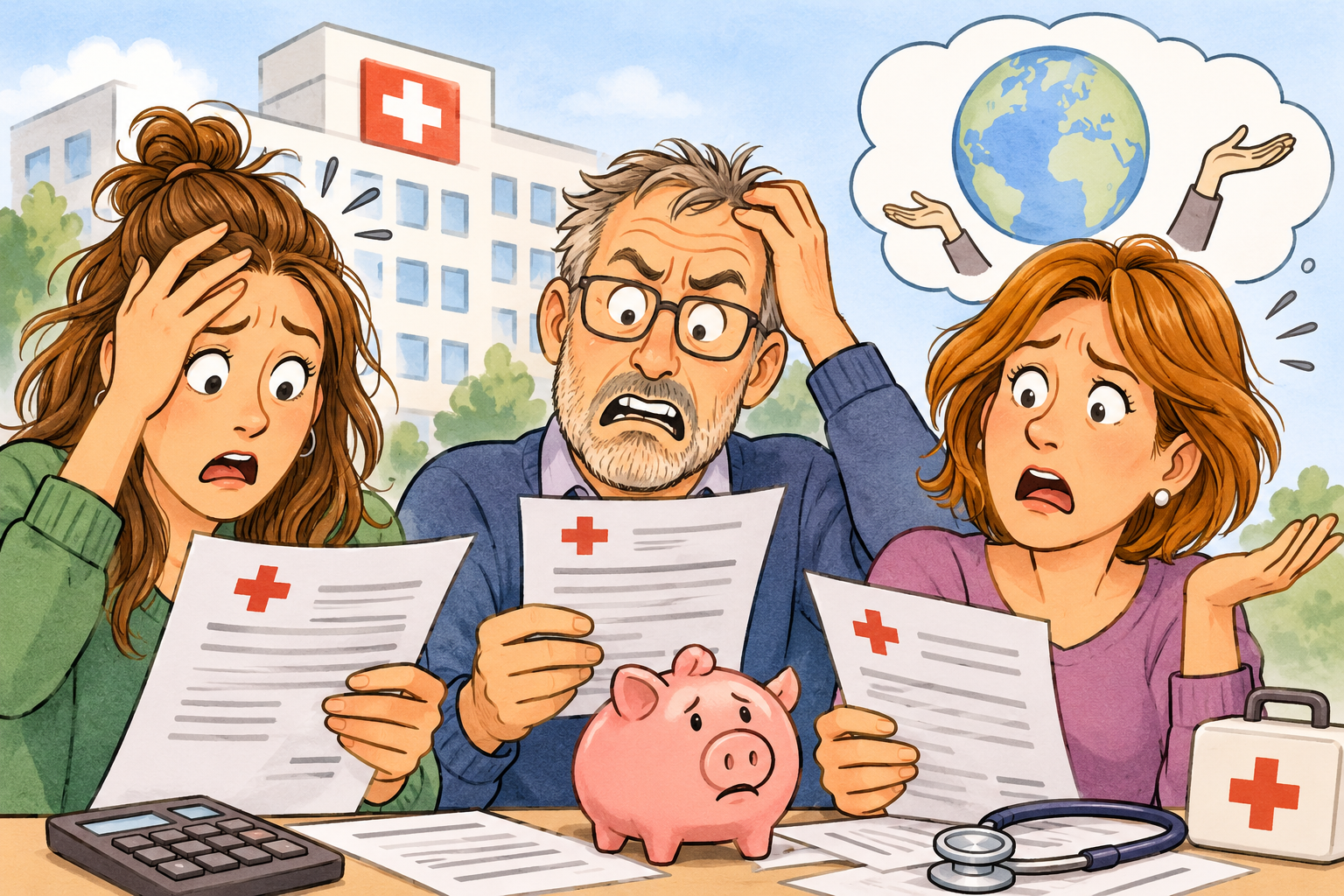
Let me tell you three stories.
Karin, a 25-year-old woman, lost her father and turned to the healthcare system for help with mild depression following her bereavement. Referred to a psychiatrist, she took psychiatric medication for a short period and is now feeling better. But health insurers refuse to offer her any supplementary insurance: she is now considered a high-risk patient. This means she can only rely on basic mandatory health insurance, with no possibility of accessing additional coverage. When she was informed of this, Karin became anxious. She called her psychiatrist, who prescribed a mild anti-anxiety medication once again. The brief telephone consultation was billed to Karin according to the national medical tariff and cost around CHF 42. This made Karin so angry that it completely cancelled out the calming effect of the medication.
Reto, a 58-year-old man, suffered a stroke and recovered well (at least in theory). However, after noticing some minor cognitive problems that had not been there before, he contacted his family doctor. The doctor played down his concerns, saying that Reto had always had high blood pressure and implying that this was more or less «all there was to it». Reto has been waiting eight months to see a neurologist, but he seems to be hitting a brick wall: first, his GP refuses to refer him to a specialist; then he puts him on a waiting list that seems endless; and finally, because Reto keeps insisting, the GP says he wants to see him again. Each appointment costs around CHF 170, so Reto has already paid CHF 510 for unnecessary visits to his family doctor and still hasn't managed to see a neurologist. His blood pressure went up even further when he saw the GP's bills.
Brigitte, a 39-year-old woman, developed hypothyroidism after giving birth, and it never went away. Here too, she asked to see a specialist: for months, her GP refused to provide a referral (without one, an endocrinologist won't accept a new patient); for months, she was only sent for blood tests, but no specialist took over her care. Her GP says that in many cases this kind of dysfunction resolves on its own after childbirth. The only problem is that Brigitte gave birth four years ago, and her condition hasn't resolved at all. The seven very brief emails exchanged between Brigitte and her doctor (Brigitte asking to see an endocrinologist, the GP replying in one line that she didn't consider it necessary, Brigitte insisting, the doctor refusing, Brigitte asking at least for further tests) cost Brigitte CHF 249.
What do these stories have in common? Perhaps only that the Swiss healthcare system is desperately trying to cut costs. People are paying increasingly high amounts, yet are being denied essential services. According to the news, the problem is that the population is ageing. According to Brigitte, it's the fault of that idiot of a family doctor. According to Reto, it's the neurologists' fault. Karin, on the other hand, blames the national medical tariff. None of the three, however, thinks that things can or should be changed. They remind me of a line from Bocca di Rosa, a song by Fabrizio De André: «The countermeasures, up to that point, were limited to ranting». And I wonder whether, and when, the Swiss will try to go beyond ranting and actually demand change.
Let's stop for a moment and think about this. The Swiss healthcare system is considered excellent, but perhaps not everyone knows how it works, so let me give you a brief overview. Every resident is required to have basic health insurance, paying a monthly premium that can easily be around CHF 400 (depending on age, place of residence and the «insurance model» chosen). But the premium does not necessarily cover medical expenses from the very first franc. Every year, you have to pay an excess out of your own pocket, ranging from CHF 300 to CHF 2,500, and then contribute a further 10% towards medical costs (the co-payment), up to a maximum of CHF 700.
In other words, on top of insurance premiums, you need to be prepared to pay up to CHF 3,200 a year out of your own pocket if you need medical care. And that's without taking into account any supplementary insurance (for dental care, glasses, hospital stays…).
I've always found this absurd, because people choose how much to pay each year based on how much they «bet» they will need healthcare services in the coming year. Let's look at two examples:
Scenario A: I bet that I won't get ill and won't need medical services, so I choose the cheapest premium: CHF 370 a month (this doesn't apply to everyone, but it's a realistic figure, so let's use it as an example), which corresponds to the highest excess. This means that if I need healthcare, I'll have to pay the first CHF 2,500 myself. Any further expenses will be covered by the insurer, apart from the co-payment (up to CHF 700 a year). So, in total, I spend CHF 4,440 a year on premiums, plus up to another CHF 3,200 if I need medical care (a total of CHF 7,640).
Scenario B: I know that if I want to have a preventive gynaecological examination and a mammogram, I'll spend at least CHF 650 (I know because that's what I spent last year). This means I'll already exceed the minimum excess of CHF 300. So I choose that option, even though it comes with a higher monthly premium (CHF 500 a month). In this case, I'll only have to pay the first CHF 300 myself; the insurer will cover the expenses above that amount (apart from the co-payment, which is still capped at CHF 700 a year). In this scenario, the amount I definitely pay is higher (CHF 6,000 rather than «just» CHF 4,440 in insurance premiums), but the total amount I pay only if I need medical services is lower, with an annual maximum of CHF 7,000 instead of CHF 7,640.
So, depending on whether I've made the right bet about my healthcare needs for the coming year, I could save CHF 640. In fact, I could make even riskier bets: knowing that I'm short-sighted, I could take out supplementary insurance that reimburses part of the cost of corrective lenses (CHF 150 a year, in exchange for an additional monthly premium of CHF 12, or CHF 144 a year. That means I save CHF 6 if I need a new prescription next year, or waste CHF 144 if I don't). Or I could take out supplementary insurance for preventive gynaecological examinations (and I think that's a pretty good bet, because preventive check-ups are worth having anyway, especially since the ovarian cyst I had removed last year alone cost CHF 8,200 in hospital stay expenses and CHF 5,840 in surgery. If one lazy ovary has generated costs of over CHF 14,000, I dread to think what Reto's bills might look like).
These are just examples, but they should give you an idea of how people in Switzerland pay high healthcare costs and how the system involves a kind of «bet» on what it is worth paying for. Personally, I find it a little sadistic.
Now let's go back to the stories I told you at the beginning: Karin, Reto and Brigitte have every right to be angry. But when you ask them why they don't support a popular initiative to change things (Switzerland is full of popular initiatives; there's practically a referendum every week, and the Swiss are rightly very proud of their democracy), they shrug and say: «Well, things are worse elsewhere».
The Swiss population seems to have a very high tolerance threshold for certain situations. Premiums keep rising, healthcare expenses are becoming increasingly burdensome, and yet the system continues to be regarded as essentially untouchable.
And when someone complains, the answer is often that «things are worse elsewhere».
But since when should the fact that things work worse elsewhere stop us from demanding that they work better here? Couldn't we stop considering normal situations that really shouldn't be normal? I'm not suggesting a revolution, just asking questions, demanding answers, having a public debate and refusing to accept things passively.
There's a kind of code of silence, a fear of speaking out, and that particular form of conformity that prevents people from questioning anything presented as a national point of excellence. As though raising the issue were somehow inappropriate.
Referendums are held to decide whether cows with horns should receive subsidies (I'm not joking), but the healthcare system is untouchable.
Obviously, I don't want to portray the entire population as passive. There are patient associations, popular initiatives, referendums and campaigns. The interesting question is why, despite all this, there hasn't been enough political pressure to bring about a radical change to the model.
A system doesn't become fair simply because everyone has grown accustomed to its injustices. Or does it?