Tell Me What We Need
When doing a job means becoming the designer of your own role, your own salesperson, and a seeker of sponsors
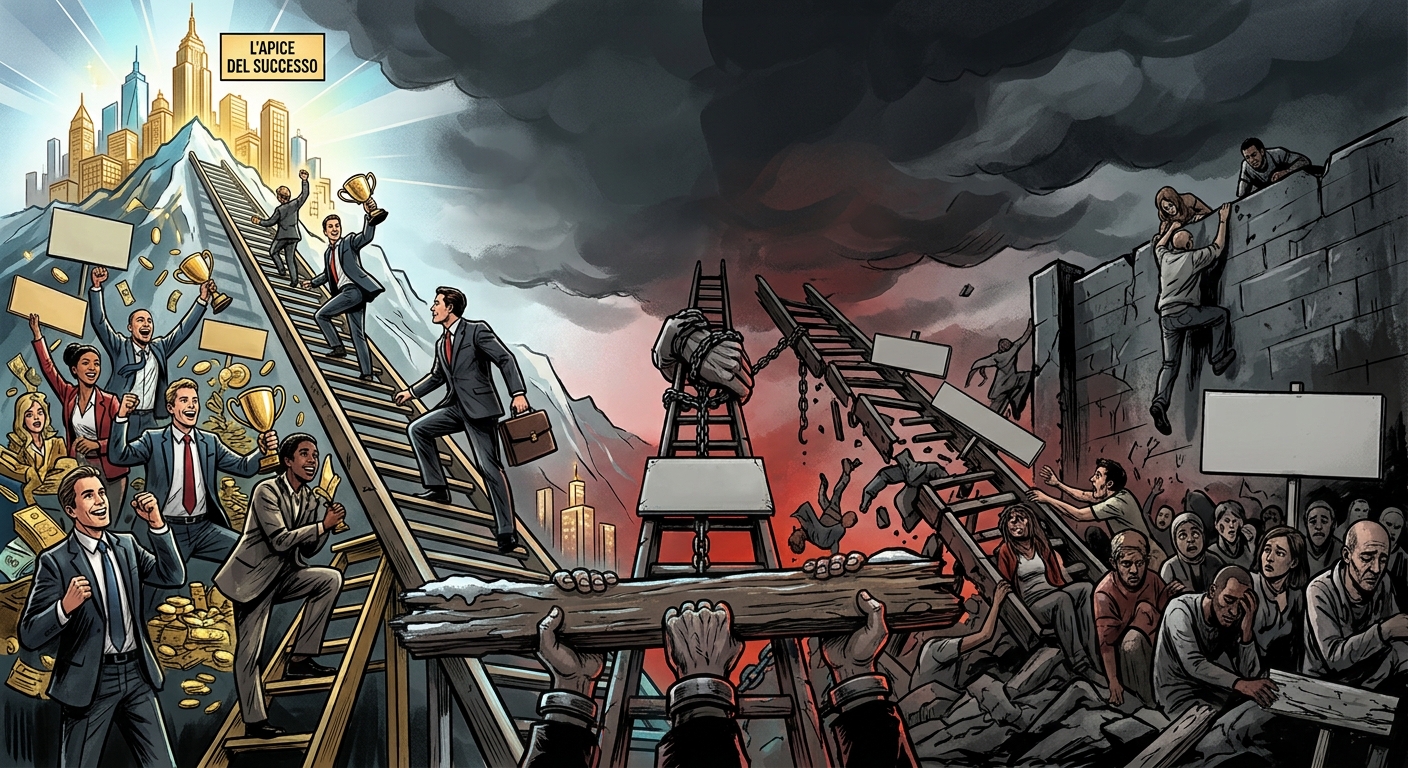
I have always been the kind of person who works better in a supportive environment than in a competitive one. Competition makes me anxious, and I often feel it does not even lead to great things. I use the supportive/competitive dichotomy as a simplification: I know very well that in the real world the two often coexist. What strikes me is the balance between them, which in recent years seems to have been tilting increasingly in one direction.
Let me give you an example. Lately, I have been seeing job advertisements that place an ever greater emphasis on competition. And I am not just referring to the fact that there may be hundreds of candidates for a single position. I mean advertisements for jobs that do not actually exist (yet): you are offered a job, but you have to invent the job yourself. For example (I will not name names, but this is a true story): "We are looking for someone to lead a project." Then you read the full description and discover that there is no project. The candidate must propose a project aligned with the organisation's mission, addressing a topic of strategic interest for the future, and submit a detailed plan describing how the work would be carried out, what funding would be needed in each year, and what results are expected. Sometimes, the candidate is also required to have an internal "sponsor": they must persuade the head of one of the departments to write a letter recommending and supporting them.
Let's stop for a moment. I am supposed to contact a department head at a company (or research centre, or university) and say, "Hey, you know what? You need someone to do this job, in this particular way, and deliver these results. I want to do it, so please write me a letter of recommendation."
…Am I the only one who feels uncomfortable with this?
I understand the logic: autonomy, freedom, projects chosen for their relevance. And yet I wonder what this kind of mechanism actually selects for. What kind of person wins. And above all, what kind of person loses.
I do not think competition should be abolished. It is perfectly reasonable for someone with an interesting, innovative idea to be able to propose it and obtain the space and funding to work on it. But that is what European calls for proposals, government funding programmes and similar schemes are for. Turning this into a job advertisement for an organisation that hires people to do a job, then asks them to explain what the strategy should be and what needs to be done, seems to me the perfect expression of a world in which all responsibility is shifted onto the individual: can't find a job? You need to try harder, sell yourself better, and so on (I wrote about this here).
This mechanism did not begin with these job advertisements. Sociologist Richard Sennett, in The Corrosion of Character (L'uomo flessibile in Italian), was already describing in the late 1990s how flexible, project-based work could erode the things that hold people together over time. When everything is temporary, it becomes harder to build lasting relationships and learn to rely on one another.
Philosopher Michael Sandel, in The Tyranny of Merit, adds another piece to the puzzle. In a society that rewards individual merit, those who succeed tend to think they owe everything to themselves, while those who do not succeed tend to feel that they alone are responsible. If you have to build the job yourself, success is your achievement and failure is your fault. There is little room left to acknowledge that no one gets anywhere without other people.
One thing is to deserve a job opportunity; quite another is to have to create, all by yourself, the opportunity that an institution is supposed to offer you.
I would like to live in a world where people can work without constantly competing to be the best (everyone else has to work too, don't they? I mean all those who are not number one), where you do not have to trample on someone else to earn a salary, and where an employer has at least some idea of the problem they want to solve, instead of asking a new employee to invent that as well.
Am I asking too much? What do you think? Can we build a world like that? And how?