What will digitalization change in our lives over the next few years?
October 2026
The Interface | Technology, Institutions, Society
What will digitalization change in our lives over the next few years?
It is a bigger question than it looks, because the word covers very different topics, each with its own experts and its own policies.
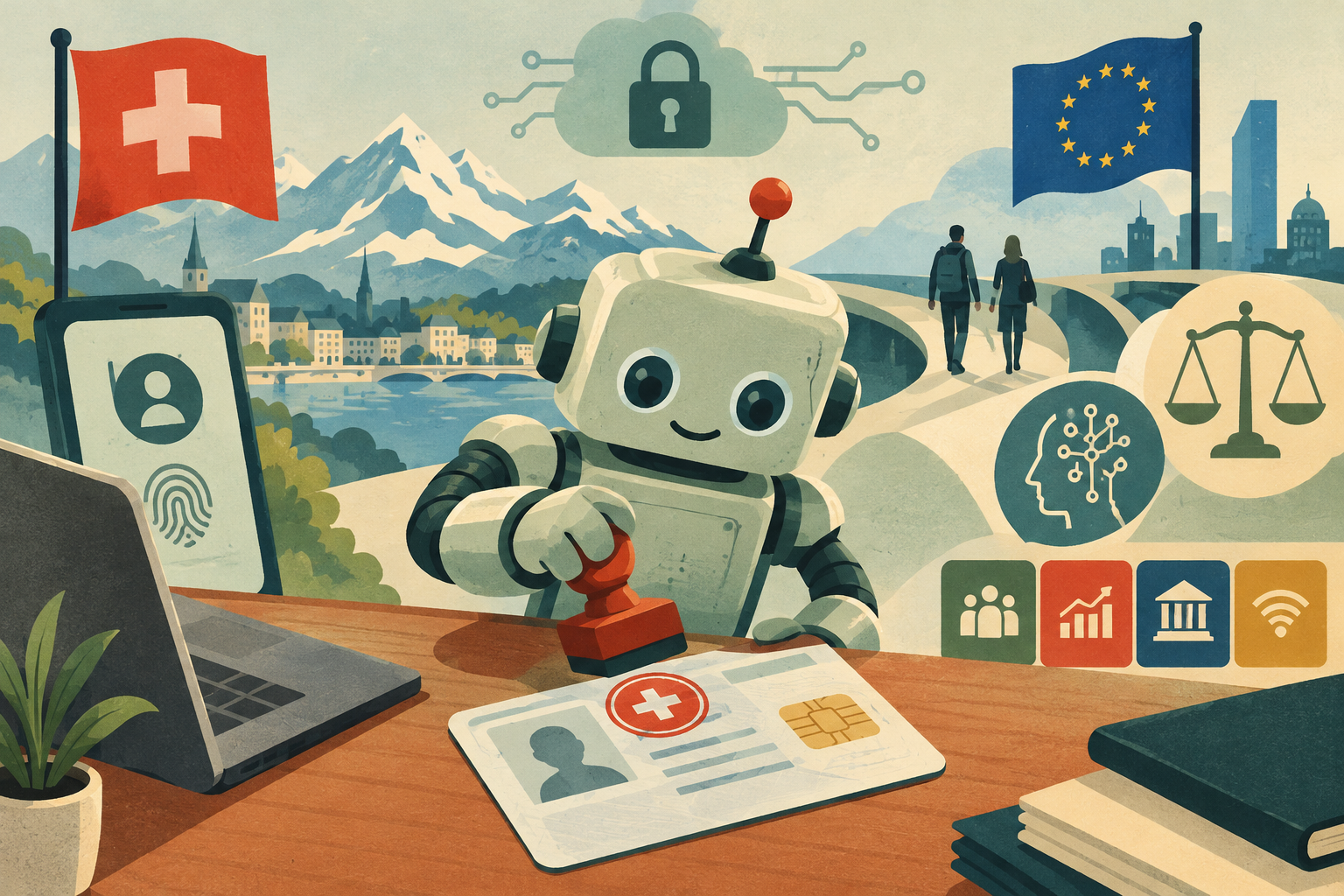
Switzerland updates its Digital Switzerland strategy every year. For 2026 the Federal Council chose digital sovereignty, the role of Switzerland as a digital host state and the introduction of the e-ID. Voters approved the e-ID in September 2025, but its launch has since been postponed, with no new date, because of new security challenges linked to AI. On AI itself there is still no specific law: a consultation draft to bring the Council of Europe’s AI Convention into Swiss law is due by the end of 2026.
Sovereignty deserves a closer look. The Federal Council’s report of November 2025 defines it as the state’s ability to control and act in the digital space in order to carry out its tasks. That is a broader idea than asking where data are stored: the Federal Council also wants to examine technical and international-law measures to protect public authorities’ data from access by other states. Recent data leaks, including one at an external software supplier of a public institution, suggest that what happens along the chain of suppliers matters as much as where the servers stand. Keeping data here may be necessary for some data…but is it enough?
The EU follows its Digital Decade programme, with 2030 targets for skills, businesses, public services and infrastructure. The 2026 report notes progress and gaps: ICT specialists were 5 percent of employment in 2025, against a target of 10 percent. In July 2026 the Digital Omnibus on AI entered into force, postponing the AI Act rules for high-risk systems to December 2027. Reactions were mixed.
Nobody knows what comes next, but there are two opposite scenarios. In the first, digital identity and similar tools become quiet, trusted infrastructure, and Swiss and EU systems end up compatible because people and companies cross the border every day. In the second, rules and timelines diverge, institutions spend more energy on compliance than on use, and the skills gap slows everything down. I suppose we will face a mix of both.
What do you think? And which digital change will matter most in your life over the next five years?
Sources at the end of the article.
The Interface | Technology, Institutions, Society
#InterfaceTechInstitutionsSociety #DigitalPolicy #CriticalThinking
Sources
Digital Switzerland Strategy 2026
Federal Council press release, 12 December 2025
Read the press release
e-ID referendum result
28 September 2025 (50.4% yes)
Read the report on SRF
e-ID: new timeline
Federal Office of Justice press release, 30 June 2026
Read the press release
Artificial intelligence regulation in Switzerland
Federal Office of Communications
Read the official overview
Federal Council report on digital sovereignty
Press release, 26 November 2025
Read the press release
EU State of the Digital Decade 2026
European Commission, 17 June 2026
Read the report announcement
ICT specialists in the EU
Eurostat, Digitalisation in Europe 2026
Explore the data
Digital Omnibus on AI
Regulation (EU) 2026/1744, Council timeline
Read the timeline
Reactions to the proposed changes to the AI Act
Reuters, via Business & Human Rights Resource Centre
Read the report