Technical performance is necessary, but it has never been sufficient.
October 2026
The Interface | Technology, Institutions, Society
Technical performance is necessary, but it has never been sufficient.
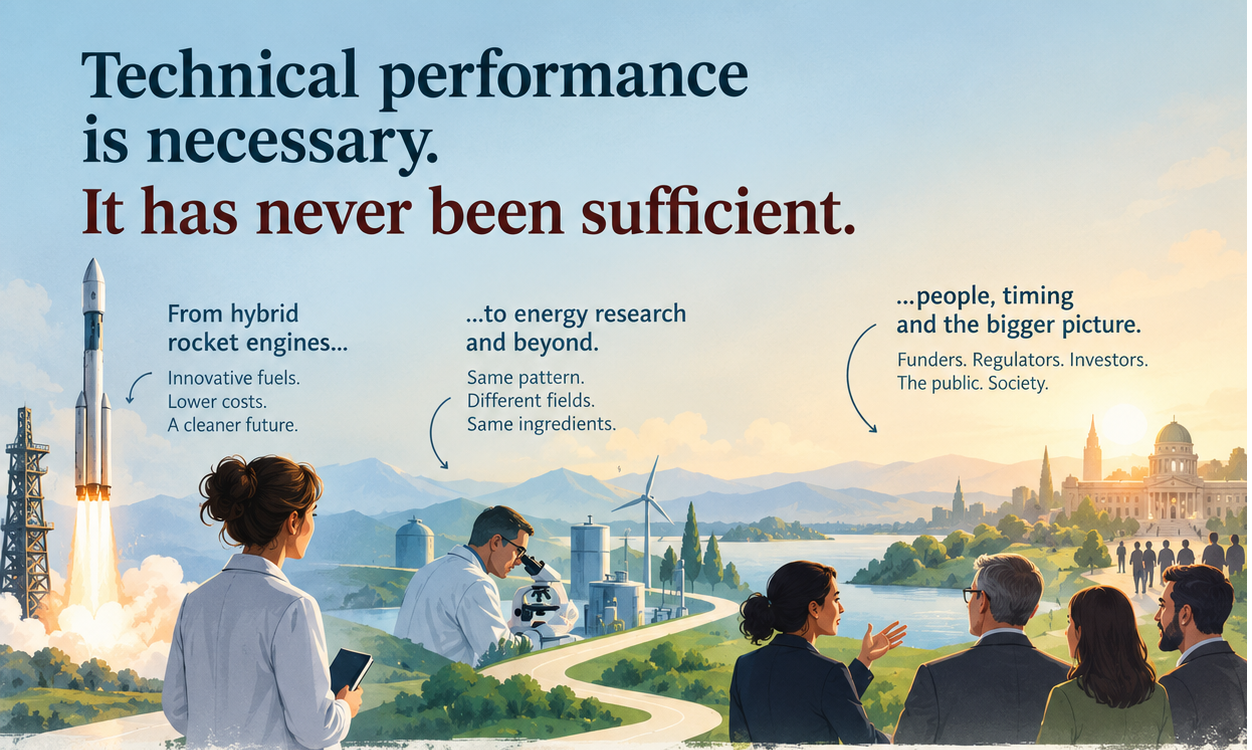
I started my career on hybrid rocket engines: innovative fuels meant to make access to space cheaper and kinder to the environment. Twenty years later, after many projects in aerospace propulsion and energy research, I keep seeing the same pattern: whether a line of research moved forward or stalled rarely depended on the science alone. It depended on whether the people who fund, regulate and invest could see why it mattered, and on whether the timing matched what society was paying attention to.
This is not anyone's failure: attention depends on many factors, research takes decades…And basic research can look very far from any application, until it turns out to be the exact step that makes the breakthrough possible.
Take a question I've heard many times: why go to Mars when there are so many urgent problems to solve here on Earth? It's a fair question, and no engine performance data can answer it. It's about priorities, time horizons, and what we hope a technology will make possible. Answering it well takes someone who can explain what the research is for.
What I learned: being able to explain a research line's impact on society, in the language of institutions, investors and the public, is part of how technologies get built. It creates the trust that long-term investment needs.
I often wished there was someone who understood the science well enough to explain it to decision-makers, and the decision-makers' constraints to the scientists. That role is often nobody's job. It should be someone's.
Think of a technology you work on or follow. At what point did it stop being a purely technical question? And who helped decision-makers see what was at stake?